
- WooCommerce
- Figma
How Vārpas 1 Turned Manual Multi-Channel Ordering Into a Centralized WooCommerce Workflow
Vārpas 1 was already successfully selling its products, but the previous website was primarily informational rather than transactional. The project objective was to turn a manual ordering process into a structured eCommerce process.
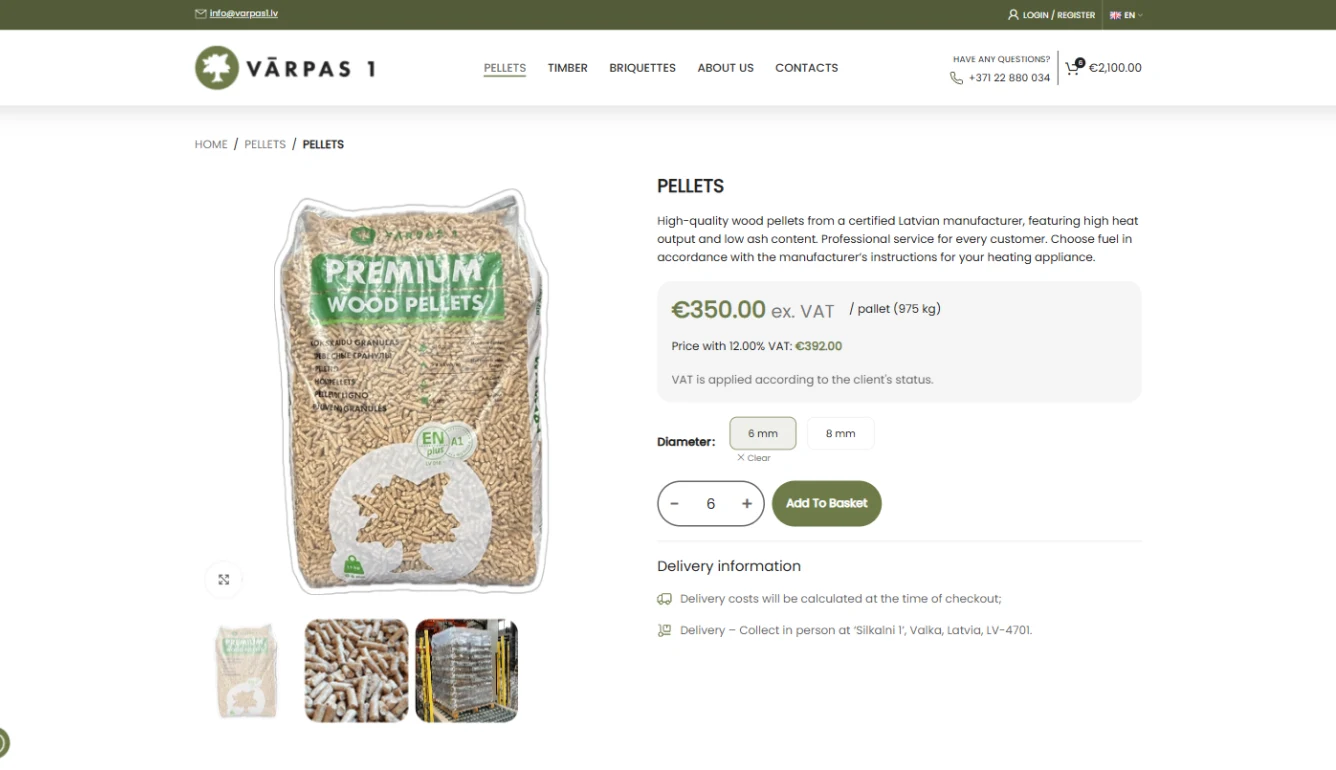
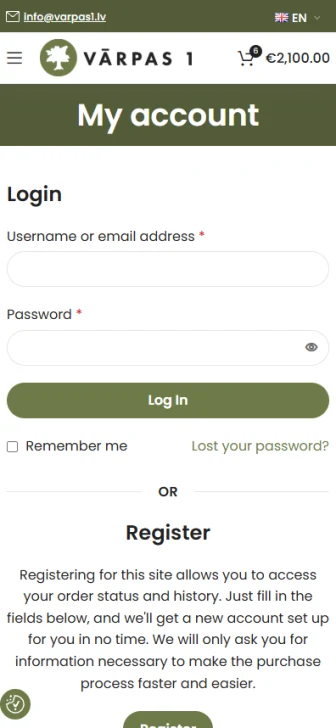
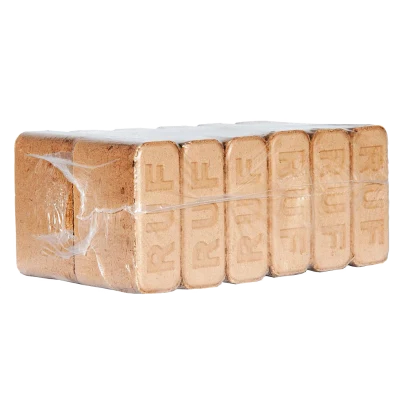
- Manual multi-channel orders centralized in WooCommerce
- Delivery calculations automated
- Orders geographically organized for logistics planning
Vārpas 1

Vārpas 1 was already successfully selling its products, but the previous website was primarily informational rather than transactional. Orders were received manually through phone, email, WhatsApp and direct communication, requiring employees to collect and process customer information themselves.
- Latvia & Estonia — B2C + B2B
- varpas1.lv
- WordPress / WooCommerce
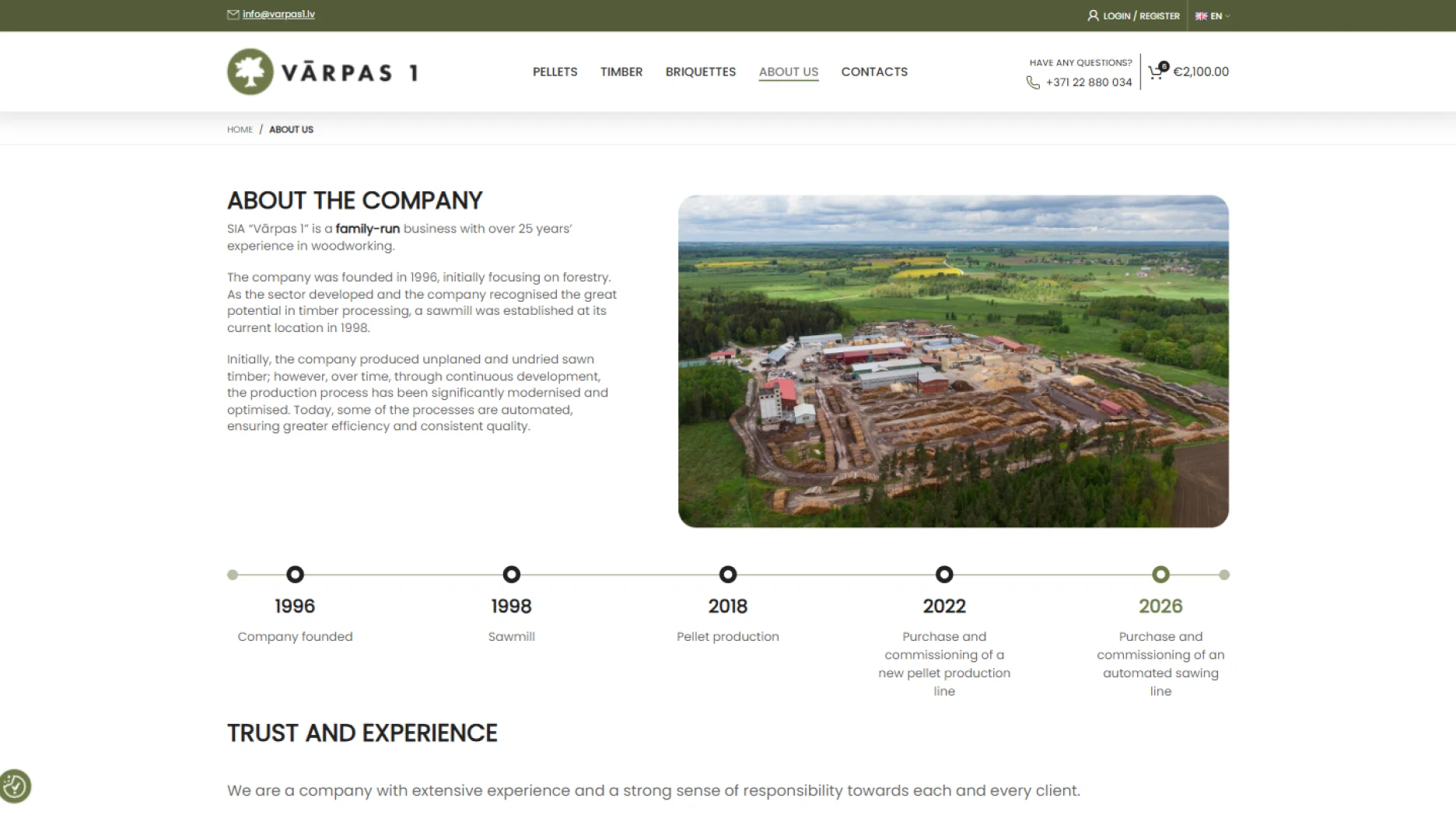

Services Provided:
- New WooCommerce eCommerce Platform
- B2C/B2B Ordering
- Custom Pricing
- VAT Logic
- Delivery Automation
- Logistics Workflow Automation
- Analytics
The Challenge
The Starting Point
Vārpas 1 was already successfully selling its products, but the previous website was primarily informational rather than transactional. Orders were received manually through phone, email, WhatsApp and direct communication, requiring employees to collect and process customer information themselves.
What the Client Believed Was Wrong
The core problem was not simply insufficient online sales. A significant part of an already-functioning sales process depended on manual order collection and administration. The company needed to transform that process into a structured digital workflow.
What Had Already Been Tried
The company already had a website and established offline/direct sales channels. Customers could successfully order products, but the process relied heavily on manual communication and employee involvement rather than a structured eCommerce workflow.
Why It Needed Attention
Vārpas 1 wanted a modern eCommerce system that could allow customers to place orders independently while reducing the administrative work required from employees. The company approached WD Market in Q4 2025 to develop the new solution.
Risk of Doing Nothing
As order volume continued, employees would remain responsible for manually receiving and processing orders from multiple communication channels. Delivery calculations, customer-specific requirements, order documentation, and logistics organization would continue consuming employee time that could instead be used for higher-value work.
Constraints That Shaped the Solution
The eCommerce logic was considerably more complex than a standard WooCommerce store. The system needed to support B2C + registered B2B customers, individual pricing, different VAT treatments, reverse VAT, product-specific VAT rules, pallet-based delivery calculations, geographic delivery pricing, multilingual content, local pickup and internal logistics organization.
What Success Needed to Mean
Customers should be able to complete orders independently online while the system automatically handles as much of the pricing, VAT, delivery, documentation, and order organization as possible. Success is therefore primarily operational efficiency, easier ordering and reduced manual work, rather than only increasing traffic or conversion rate.
Our Approach
-
What the Evidence Showed
The largest eCommerce opportunity was process automation rather than simply conversion optimization. Vārpas 1 already had customers and demand. The friction existed in how those orders were collected and processed internally. The website therefore needed to function as an operational business system, not merely as a digital catalogue or marketing channel.
-
What We Prioritized First
Automating the core order journey from customer purchase through internal processing. The biggest business value came from moving orders away from phone/email/WhatsApp and into a structured system capable of automatically handling pricing, VAT, delivery and logistics requirements.
-
How We Delivered It
WD Market developed a new four-language WooCommerce platform supporting Latvian, Estonian, Russian and English. The solution includes B2C/B2B functionality, B2BKing, customer-specific pricing, custom VAT logic, a custom pricing calculator, delivery-price automation, local pickup, geographic order organization, invoice/document functionality, EveryPay, GA4 and Microsoft Clarity.
-
How the Engagement Evolved
With the main eCommerce and automation system now completed, the priority has shifted from building → observing. Instead of immediately launching another development phase, WD Market and Vārpas 1 will allow approximately six months of real usage to reveal genuine customer and operational friction before deciding what should be improved next.
The People Behind The Work
Project / Account Management, UX/UI Design, WooCommerce Development, QA, Analytics & Technical / Automation Specialists.
-

Einārs Melderis
Project Manager
Focus: Project Delivery · Communication · Coordination
-
Lauris Priede
Chief Technology Officer
Focus: Architecture · Integrations · Performance
-

Deins Grets
Head of UI/UX & CRO
Focus: UI/UX · Usability · Customer Journeys · CRO
-

Anush Avetisyan
QA Team Lead
Focus: QA · Payments · Integrations · Release Quality
-

Rainers Leitarts
Full-stack Developer
Focus: Development · Integrations · Checkout
-

Mārcis Motcats
E-commerce System Engineer
Focus: Full-scale enterprise systems · Automation Workflows · Technology


 25+ Developers, Designers, CRO Specialists & others
Strategic Decisions
-
Recommendation
The client’s underlying requirement was valid: the business needed a purpose-built eCommerce system capable of digitizing an existing manual ordering process.
-

What We Deliberately Did Not Recommend
We did not treat this as a traditional “increase traffic and conversion at all costs” eCommerce project. The company already had an established business and defined geographic market. The greater opportunity was reducing repetitive manual work and improving operational efficiency. We also do not recommend immediately adding unnecessary features now that the platform has launched.
-

Rebuild / Redesign / Spend Decision
The client wants approximately six months of real-world usage before making substantial further changes. The correct approach is to allow customers and employees to use the new system, collect evidence, and then improve genuine friction rather than continuously adding functionality without evidence.
Results We Delivered
-
Measured Results
Manual multi-channel order collection → centralized eCommerce ordering. Custom delivery calculations → automated based on customer and order parameters. Incoming orders → geographically organized for logistics planning. B2C and B2B purchasing → supported within one WooCommerce environment.
-
Evidence and Metrics
The new system replaces order collection across multiple manual channels with a centralized WooCommerce purchasing process. It also automates delivery calculations using factors including postal code, delivery region and number of pallets, while incoming orders can be organized geographically to support delivery-route planning.
-
What the Client Gained Beyond the Metric
Vārpas 1 gained a digital operational system rather than simply a new website. Customers can order independently, while pricing, VAT, delivery, documentation, B2B requirements and logistics organization are increasingly handled within one structured workflow. This reduces dependency on employees manually coordinating each transaction.