Usability Audit

Know which improvements matter before you invest in development, redesign or marketing.

A structured review of how your customers actually move through your store, delivered as measurable findings and a prioritised roadmap of usability improvements.

4.9 on Google4.5 on Trustpilot AuditedCasidaStoic BeautyTinyWinsJuveNaturals
Anush Avetisyan, WD Market
Tomass Bērziņš, WD Market
Client reviews

Working with WD Market on our e-commerce store usability audit was an outstanding experience from start to finish. From the very first interaction, their communication was prompt, professional, and positive. The insights and recommendations provided were highly professional and genuinely valuable for our business. Special thanks to Tomass—he is a true expert who deeply understands e-commerce and delivers top-tier results. Highly recommended!

Flizes LvAugust 2026

Working with WD Market for a CRO audit was a great experience. Their decision making is data driven and not just vibes! Each part of the process was clearly presented and made good business sense to tackle step by step, with priority projects made clear so that we can approach the most urgent items first.

Stoic BeautyJuly 2026

I am very satisfied with the online store audit and the recommendations that need to be implemented on the website. I especially appreciate that the company not only provided suggestions, but also created a real mockup of how the website could look after the improvements. That immediately convinced me that the changes are necessary and could be very valuable both visually and from the customer experience perspective.

Renate RozeApril 2026

Excellent experience working on my Shopify website audit and design. They were knowledgeable, thorough, and clearly understood the platform inside and out. The recommendations were practical and made a real difference to how the site looks and performs. Communication was smooth throughout, and the work was delivered on time. Definitely recommend to anyone looking to improve their Shopify store.

Jimmy LiJune 2026
The problem

Many e-commerce businesses invest heavily in acquiring visitors before fully understanding how customers interact with their store.

Tomass Bērziņš, CRO strategist at WD Market
01

How it is usually decided

Improvements are often prioritised based on assumptions rather than observed behaviour, making it difficult to identify which changes will have the greatest impact on usability, customer experience and overall platform performance.

02

What an audit changes

A usability audit replaces assumptions with evidence, allowing improvements to be prioritised according to measurable user behaviour and implementation effort.

Your situation

You have traffic, the platform largely works, and it is difficult to determine which improvements matter most.

So changes are made in the order they were suggested, and their effect on customers is rarely measured afterwards. That position is the same whether conversion performance is strong or below expectation.

01

Conversion has plateaued

Website traffic is stable but conversion performance has plateaued

02

Spend without evidence

Significant marketing investment is made without clear evidence of user experience bottlenecks

03

Redesigns without lift

Previous redesigns delivered limited measurable improvement

04

Priorities set by opinion

Platform improvements are prioritised by opinion rather than observed customer behaviour

05

Data never analysed

Analytics platforms collect valuable data that has never been fully analysed

06

No improvement roadmap

There is no structured roadmap for continuous usability improvements

Whichever of these applies, the audit is the same. What differs is what it identifies.

How delivery works

Ten working days, and every one of them is visible.

Who carries out each step, what happens in it, and what is required from your team.

Day 0

Access

Your team

You grant Shopify, GA4 and Microsoft Clarity access. If Clarity is not installed, we implement it and allow sufficient sessions to accumulate. This is the only setup required from your team.

Days 1–2

Data validation

Behavioural analyst

Bot traffic and irrelevant-geography sessions are excluded before analysis begins, so findings are based on genuine customer behaviour. This step is frequently omitted elsewhere, producing inflated figures.

Days 2–4

Journey mapping

CRO strategist

Your customer journey measured against your own business objectives rather than generic benchmarks. Where users disengage, at what rate, on which device.

Days 3–6

Session review

Behavioural analyst

A specialist reviews recordings in detail, distinguishing between customers who completed a purchase and those who did not, identifying what differs in their behaviour. This is the most time-intensive step and identifies issues analytics cannot reveal: non-functioning elements, repeated interaction attempts, hesitation at decision points.

Days 5–8

Attention analysis

CRO strategist

Scroll depth, click distribution and attention across home, category, product and cart pages. Where the page stops being read.

Days 7–9

Hypotheses and prioritisation

Strategist + developer

Each finding becomes a testable hypothesis with a defined success metric, then is ranked by business impact and implementation priority, not by ease of delivery.

Day 10

Presentation

Your team + ours

We present the document page by page and answer questions from your team. Recorded, so stakeholders who could not attend can review it.

Ongoing

Continued access

Unbilled

A shared WhatsApp group with the team, including the specialist who reviewed your session recordings. This ongoing collaboration ensures findings can be discussed during implementation, helping teams make informed technical and business decisions long after the audit has been delivered. Strategy discussion is not billed. Implementation tasks enter a ticketing system with written estimates, and you approve which proceed. Nothing is charged without an approved estimate.


What you get

Eight deliverables, all defined.

  • A written audit document, 16–30 pages depending on platform scope. Findings and supporting data, not a summary presentation.
  • Journey analysis across Shopify, GA4 and Microsoft Clarity, with invalid traffic excluded.
  • Scroll-depth, click and attention analysis across home, category, product and cart pages.
  • Session-recording review comparing completed and abandoned journeys.
  • Visual concepts showing how key pages could be restructured.
  • A prioritised roadmap: immediate priorities, subsequent phases, and lower-priority items.
  • A live presentation, recorded.
  • Continued team access following delivery, unbilled — strategy discussion with the specialists who produced the findings, including the analyst who reviewed your session recordings.
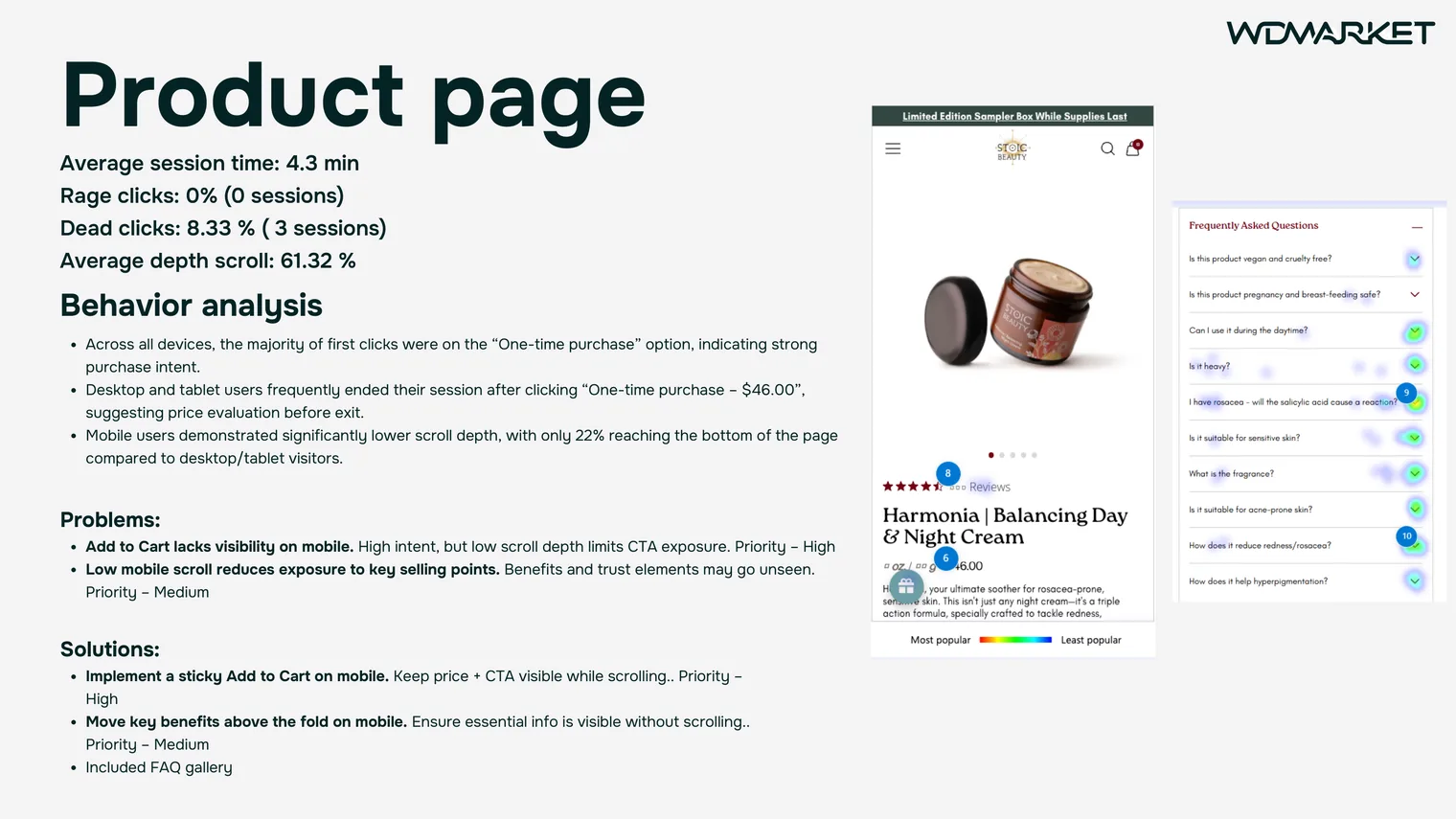
Audit report page: product-page behaviour metrics, heatmapped product page, and the prioritised problems and solutions

A page from a delivered usability audit.

Ongoing collaboration

Continued team access following delivery, unbilled.

Findings can be discussed while they are being implemented, with the specialists who produced them, including the analyst who reviewed your session recordings.

The team

People Behind The Work

Each of them owns a defined part of the audit, so you will know who reviewed your platform.

Tomass Bērziņš, cRO strategist at WD Market
Tomass Bērziņš

CRO strategist

Leads the analysis, determines business and implementation priority, and presents the findings.

From client feedback

Established that a client’s platform was performing above benchmark and that a planned redesign was not the highest-priority investment.

Anush Avetisyan, behavioural analyst at WD Market
Anush Avetisyan

Behavioural analyst

Reviews customer session recordings in detail to identify behavioural patterns, usability issues and friction points that traditional analytics cannot reveal. Remains available in the shared group following delivery.

From client feedback

Identified a non-functioning mobile navigation element, with recordings showing repeated interaction attempts followed by abandonment, on a store where 92% of purchases were completed on mobile.

Rainers Leitarts, developer at WD Market
Rainers Leitarts

Developer

Scopes each recommendation so the roadmap reflects realistic implementation effort.

From client feedback

Scoped a single-product page restructure for a founder-operated store so the decision could be made against a defined implementation estimate.

Einārs Melderis, project manager at WD Market
Einārs Melderis

Project manager

Coordination, estimates, and ensuring no work proceeds without approval.

From client feedback

On a CRO audit for a beauty brand, the client noted that every part of the process was clearly presented and priorities made explicit, so they could start on the most urgent items first.

How we work together
  • 01Strategy discussion and questions are unbilled. You do not need to book a meeting to ask one.
  • 02Implementation proceeds on written estimates approved individually. Nothing begins without one.
  • 03Engagements can conclude at audit delivery with no further obligation. The roadmap remains yours regardless.
Case studies

Different engagements, different starting points.

Each of these stores approached us with a different assumption about what was limiting performance. In two cases the evidence supported a different priority than the one the client expected. The findings below are drawn from the audit documents delivered to each business.

Case 01 · Stoic BeautyTorontosensitive skincaremobile-led

A mobile-led store where the primary navigation element was non-functional.

Stoic Beauty sensitive-skincare products: a dropper serum and a facial mist on a neutral background
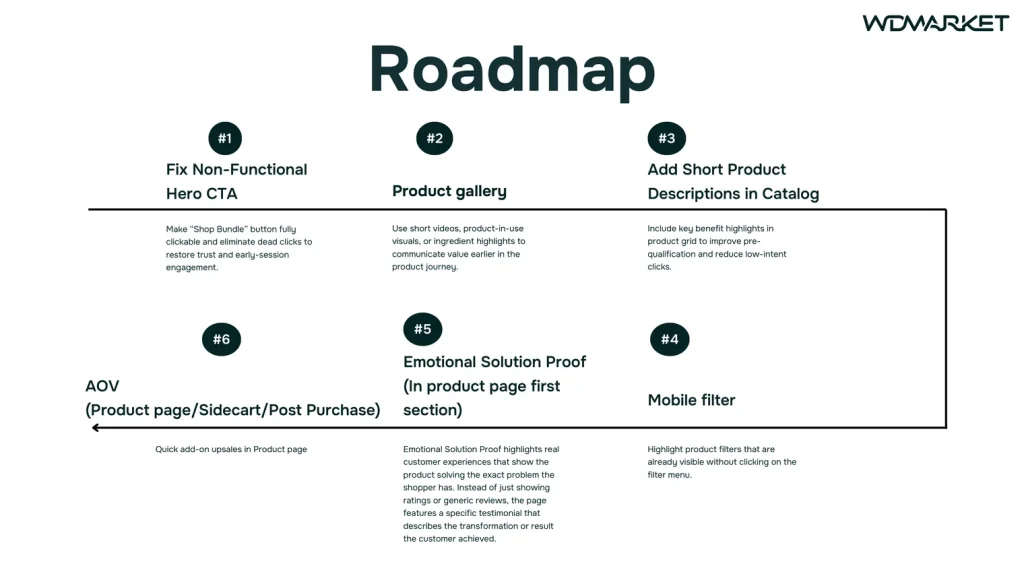
Roadmap page from the delivered audit document, showing six prioritised actions in the order they should be worked through

The prioritised roadmap page from the document delivered to this client.

92%of purchases completed on mobile
8%add-to-cart rate
3.4 minon the category page, indicating decision uncertainty rather than engagement
50%did not scroll beyond the add-to-cart section
50% stop here Not seen
Product page, scroll depth

Half of visitors did not scroll beyond the add-to-cart section. The FAQ content they demonstrably engaged with was positioned below that line, at the foot of the page.

Context

A Canadian sensitive-skincare brand. 92% of purchases were completed on mobile, with an 8% add-to-cart rate. The assumption was that performance was constrained by acquisition rather than by the on-site experience.

What the audit identified

Session recordings showed customers attempting to interact repeatedly with the primary mobile navigation element before abandoning the session — an issue that platform analytics could not have revealed, since no error was recorded. Category pages showed an average dwell time of 3.4 minutes, which the session review indicated was decision uncertainty rather than engagement: customers were comparing without sufficient information to choose. Half of product-page visitors did not scroll beyond the add-to-cart section, while the FAQ content they demonstrably engaged with was positioned at the foot of the page. Three overlays were presented simultaneously on load. Cart recommendations applied a flat increase rather than responding to the customer’s distance from the free-shipping threshold.

What we recommended

Resolve the mobile navigation issue; introduce persistent filter and sort; add outcome-led labelling and single-line descriptions to category cards; relocate the FAQ content into the gallery where attention concentrates; make cart recommendations conditional on the shipping threshold; and introduce post-purchase recommendations on the confirmation page.

Session review identifies functional issues that analytics platforms record as ordinary behaviour.

Case 02 · TinyWinsUnited Stateschildren’s nutrition

Critical usability issues addressed ahead of further acquisition investment.

TinyWins meal-booster sachets photographed among fruit, vegetables and a bowl of pasta

A US children’s nutrition brand selling a powdered supplement for selective eaters.

50%of visitors did not reach the add-to-cart section
15%reached the ingredient information that addresses the primary parental concern
15% reach ingredients 50% reach add to cart Not seen
Product page, scroll depth

Half of visitors did not reach the add-to-cart section, and only 15% reached the ingredient information that addresses the primary parental concern.

Context

A US children’s nutrition brand selling a powdered supplement for selective eaters, with active paid acquisition running at the time of the audit. The assumption was that acquisition performance was the constraint, and that additional traffic would improve results.

What the audit identified

Session recordings showed repeated interaction attempts on product images that appeared interactive but were not. Pricing was not displayed on category pages, requiring a click before customers could evaluate options. The add-to-cart control was positioned before variant selection, producing incorrect selections and abandonment. Half of visitors did not reach the add-to-cart section at all, and only 15% reached the ingredient information section — the content addressing the question most parents ask first, positioned well below the point at which the majority stopped reading.

What we recommended

Resolving the critical usability issues before increasing marketing investment, followed by a restructure of the home, category and product pages, delivered with visual concepts and a scoped implementation estimate.

Acquisition investment directed at a store with unresolved usability issues produces avoidable loss. The evidence supported sequencing the work the other way round.

Case 03 · JuveNaturalssingle productfounder-operated

The first correction was to the quality of the data itself.

JuveNaturals skincare pack and sachets styled on a pale surface beside dried flowers

A single-product brand operated by its founder, with no in-house analytics capability.

~30%of visitors reached the add-to-cart section, once invalid traffic was excluded
~30% reach add to cart Not seen
Single product page, validated sessions only

Approximately 30% of genuine visitors reached the add-to-cart section. The figures previously relied upon had been distorted by invalid traffic.

Context

A single-product brand operated by its founder, with no in-house analytics or user experience capability. The assumption was that the product page was performing adequately, based on the platform figures available.

What the audit identified

A significant proportion of recorded sessions were bot and irrelevant-geography traffic. Once excluded, the underlying figures changed materially — every metric the business had been working from had been distorted. Against validated data, approximately 30% of genuine visitors reached the add-to-cart section of the product page. Attention analysis showed the same pattern observed across the other engagements: the information customers needed in order to decide was positioned below the point at which most of them stopped reading.

What we recommended

A restructure of the product page, delivered with visual concepts so the proposed changes could be evaluated before any development commitment, alongside a clearly scoped implementation estimate based on the identified priorities.

The audit applies at any scale. For a founder-operated business, the most valuable outcome was often a reliable basis for decisions — before any change was made at all.

Case 04 · CasidaGermanyShopifymulti-product

They assumed the platform required a redesign. The evidence did not support it.

No redesign
  1. 01Measurement infrastructureReliable data before any test is run.
  2. 02Product pageWhere the purchase decision was being made.
  3. 03Add to cart → checkoutThe stage running at 59% against a 70–85% range.

The sequenced testing roadmap recommended in place of a redesign.

3.67%conversion rate, above benchmark
over 10%add-to-cart rate
39%of product-page visitors scrolled beyond the add-to-cart section
~€180,000assessed annual business impact of closing the identified average order value gap
Add to cart → checkout
Added to cart100%
Proceeded to checkout59%
Typical range70–85%
Context

A German direct-to-consumer brand operating a multi-product Shopify store, with defined business objectives covering conversion performance, average order value and customer lifetime value. The team wanted to establish whether the platform required a redesign before committing to further development investment.

What the audit identified

The store was already performing above benchmark — 3.67% conversion and over 10% add-to-cart. On the available evidence, a redesign would not represent the highest-priority investment at this stage. The measurable opportunity was elsewhere: only 59% of customers who added a product to cart went on to reach checkout, against a typical range of 70–85%. Purchase decisions were being made within the first screen of every page type, while supporting content positioned further down — trust signals, product education — was largely unseen; only 39% of product-page visitors scrolled beyond the add-to-cart section. Internal search was used far more heavily than expected, functioning as a primary navigation route rather than a secondary utility.

What we recommended

No redesign. A sequenced testing roadmap beginning with measurement infrastructure, then the product page, then the add-to-cart-to-checkout stage. Closing the identified average order value gap across existing traffic was assessed at approximately €180,000 in annual business impact.

The evidence supported leaving the design alone and directing effort at a specific, measurable stage of the customer journey.

Principles
01

Evidence before assumptions.

Every recommendation states the observed behaviour or measurement it came from.

02

Business priorities before technical solutions.

We establish the objective a change is meant to serve before scoping how to build it.

03

Recommendations aligned with implementation.

A developer scopes each item, so the roadmap reflects realistic effort rather than intent.

04

Continuous optimisation, not one-time delivery.

Each release is measured, and the result informs what is prioritised next.

Qualify & invest

Three criteria you can assess independently.

  • An active store with established order history.
  • Analytics implemented, or willingness to implement.
  • A decision-maker able to act on the findings.
Investment
From €1,500
Not included
Implementation. The audit establishes priorities; delivery is a separate, separately-scoped decision made afterwards with no obligation.
When this isn’t the right time
  • Insufficient traffic or order history.Too few sessions and orders cannot support reliable conclusions.
  • No analytics implementation, and no willingness to introduce one.Without visibility of customer behaviour there is no audit to carry out.
  • A pre-launch platform.No customers have used the store yet, so there is no behaviour to observe.

In those cases we will say so during the consultation rather than proceed with an audit.

Recurring pattern

One pattern held across all four engagements.

Attention consistently concentrated on the first screen of each page. Content positioned lower — including the information addressing customers’ primary concerns — was largely unseen.

  • 50%scrolled beyond the add-to-cart section on the product pageCase 01 · Stoic Beauty
  • 15%reached the ingredient information addressing the primary parental concernCase 02 · TinyWins
  • ~30%reached the add-to-cart section, once invalid traffic was excludedCase 03 · JuveNaturals
  • 39%scrolled beyond the add-to-cart section on the product pageCase 04 · Casida
In three of the four cases the recommended action was to relocate existing content rather than create new content.
Scope

What is included, and what can be requested afterwards.

The eight deliverables above are the audit itself. These are the boundaries around them, so the engagement is scoped before it starts rather than negotiated during it.

  • Also included

    Part of the fixed scope, alongside the deliverables above.

    • Annotated findings supported by session recordings and heatmap evidence.
    • An executive summary with implementation priorities.
    • Customer journey evaluation across both desktop and mobile.
    • Checkout and conversion flow review.
  • Can be requested after the audit

    Not part of the audit itself — scoped and estimated separately, with no obligation.

    • Design creation.
    • Development implementation.
    • A/B testing execution.
    • Implementation support via a ticketing system, with a written estimate approved per task before work begins.
    • Ongoing testing and continuous optimisation.
Success framework

What the audit is measured against.

One primary objective, and the supporting measures that show whether it was met.

Primary objective

To create a more intuitive, accessible and efficient user experience that supports sustainable e-commerce growth, grounded in observed customer behaviour.

Supporting measures
  • Improved usability across key customer journeys.
  • Reduced friction during navigation and checkout.
  • Higher accessibility and user confidence.
  • Increased decision confidence before development or redesign investment.
  • A clear, implementation-ready roadmap.
Questions

Frequently asked.

How long does the audit take?

Ten working days from the point access is granted, with the findings presented on day ten. Platform scope and data availability can move that.

What does the investment include?

A fixed-scope engagement from €1,500 — implementation is scoped and estimated separately, and nothing is charged without an approved estimate.

What access is required?

Read access to the commerce platform, analytics and a session recording tool — here, Shopify, GA4 and Microsoft Clarity. Where these are not yet in place, implementing them is arranged as part of the engagement scope.

Do you guarantee a conversion improvement?

No. Recommendations are structured as hypotheses with defined success metrics, and the results inform the direction of the next iteration.

What happens after delivery?

You keep continued, unbilled access to the analyst for strategy discussion, in a shared group with the team — including the specialist who reviewed your session recordings.

Is implementation included?

No. The audit is a fixed-scope diagnostic engagement. Implementation is optional, scoped separately, and proceeds only on written estimates you approve individually.

Next step

Book a call.

During the consultation, we’ll review your store, discuss your current challenges, and determine whether a usability audit is the right next step.

If we believe another approach would provide greater value, we’ll tell you that openly.