- WooCommerce
- Figma
- Claude
- Stripe
How Multipack Increased Average Basket Value by 40.5% While Reducing Low-Value Orders
Multipack was operating a fragmented eCommerce setup built around WordPress and a legacy Magento installation. The project objective was to build a scalable B2B-focused eCommerce platform, automate order and inventory flows, reduce operational workload, improve warehouse economics, increase average basket value and create a stronger digital sales channel for Baltic customers.
- Revenue +3.8%
- Average basket +40.5%
- Shipping & handling income +23.5%
Multipack

Multipack was operating a fragmented eCommerce setup built around WordPress and a legacy Magento installation. The outdated infrastructure required significant manual work, created operational inefficiencies and was poorly suited to the company's B2B and wholesale business model. Small, low-value orders also consumed disproportionate warehouse and customer-service resources.
- LV/EE/LT/Baltics
- multipack.lv
- WooCommerce
Services Provided:
- eCommerce Replatforming
- UX/UI
- ERP Integration
- Business Process Automation
The Challenge
The Starting Point
Multipack was operating a fragmented eCommerce setup built around WordPress and a legacy Magento installation. The outdated infrastructure required significant manual work, created operational inefficiencies and was poorly suited to the company’s B2B and wholesale business model. Small, low-value orders also consumed disproportionate warehouse and customer-service resources.
What the Client Believed Was Wrong
The existing eCommerce infrastructure had become outdated, inefficient and difficult to operate. Multipack needed a modern platform that could support both online sales and its underlying B2B business processes.
What Had Already Been Tried
Multipack had been operating a hybrid WordPress + Magento solution, with employees compensating for gaps in the technology through manual processes.
Why It Needed Attention
The legacy setup was limiting scalability and creating unnecessary manual work across order processing, inventory management and customer service. Multipack also had an opportunity to modernise the operation with support from the LIAA funding programme.
Risk of Doing Nothing
Multipack would continue spending employee and warehouse capacity processing low-value orders and manually transferring information between systems. As online sales grew, these inefficiencies would become increasingly expensive and difficult to scale.
Constraints That Shaped the Solution
The solution had to integrate with Multipack’s existing Hansa ERP and accommodate complex B2B requirements, including customer-specific pricing, wholesale functionality, stock synchronisation and different commercial conditions across order values.
What Success Needed to Mean
A modern eCommerce operation that could process more of the customer journey automatically, reduce low-value operational work, support B2B customers and improve the economics of every online order — without sacrificing overall revenue.
Our Approach
-
What the Evidence Showed
The key issue was not simply generating more orders. Too many small orders were economically inefficient: they created picking, fulfilment and customer-service work without sufficient order value. The business needed better-quality orders, not simply more orders. At the same time, manual order entry and disconnected stock information created avoidable administrative work.
-
What We Prioritized First
Business-process and eCommerce economics first. The priority was understanding how order value affected picking, fulfilment and operational workload, and which processes could be automated. This ensured the new platform solved business problems rather than simply improving appearance.
-
How We Delivered It
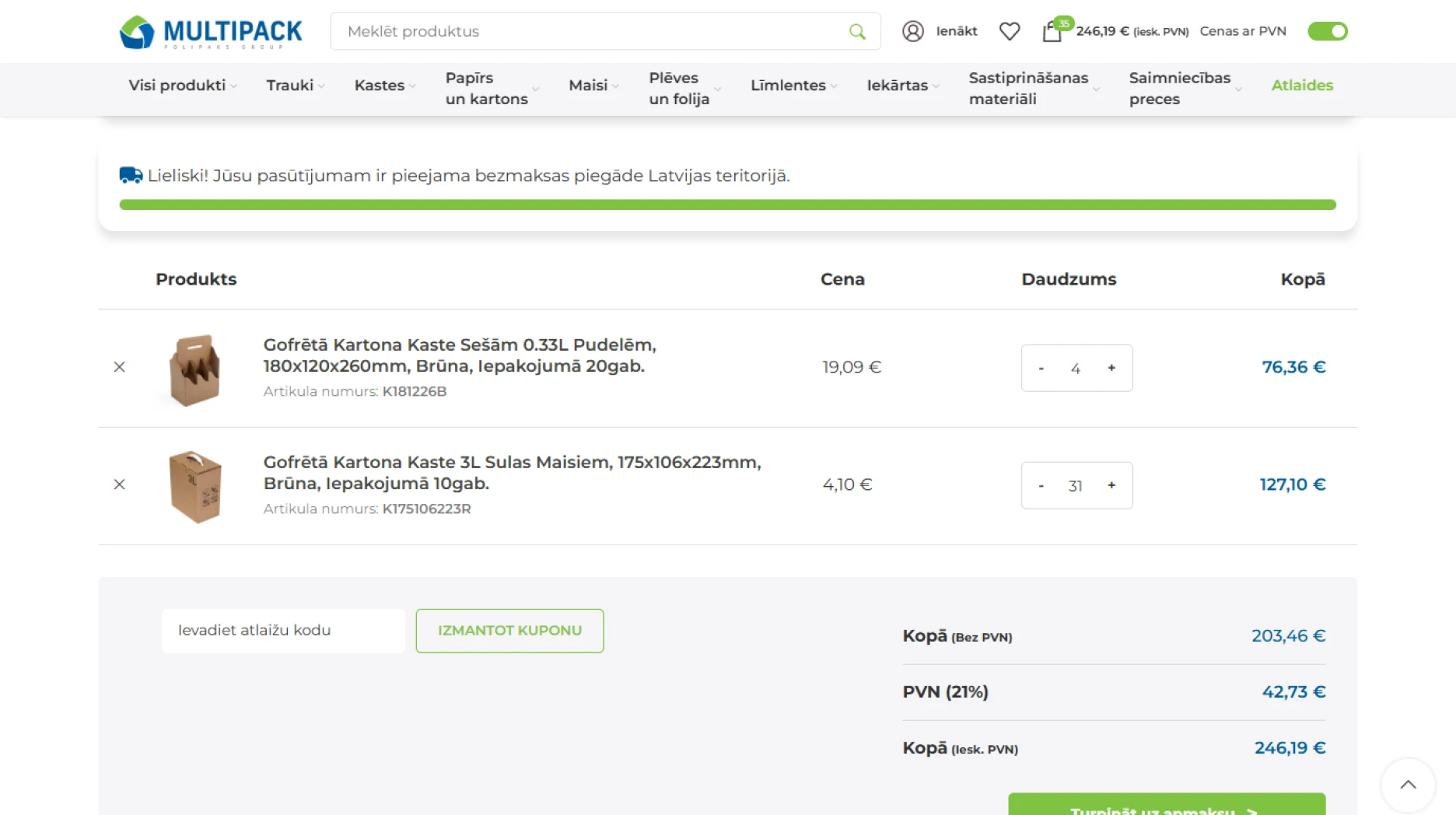
WD Market migrated Multipack to a modern WooCommerce platform and delivered a new UX/UI, Hansa ERP integration, real-time stock synchronisation, order synchronisation, B2B portal, customer-specific pricing and wholesale functionality. eCommerce analytics were implemented to measure Add-to-Cart, Reached Checkout and Conversion Rate. The commercial model was also structured around a higher MOQ and tiered processing/shipping fees.
-
How the Engagement Evolved
The strategy increasingly focused on order quality rather than order quantity. The commercial model moved toward a €30 entry threshold and tiered fees designed to discourage uneconomical small orders while incentivising larger baskets.
The People Behind The Work
Support Team Lead, Developers, eCommerce Strategist.
-

Einārs Melderis
Project Manager
Focus: Project Delivery · Communication · Coordination
-

Lauris Priede
Chief Technology Officer
Focus: Architecture · Integrations · Performance
-

Deins Grets
Head of UI/UX & CRO
Focus: UI/UX · Usability · Customer Journeys · CRO
-

Anush Avetisyan
QA Team Lead
Focus: QA · Payments · Integrations · Release Quality
-

Mārcis Motcats
E-commerce System Engineer
Focus: Full-scale enterprise systems · Automation Workflows · Technology



 25+ Developers, Designers, CRO Specialists & others
Strategic Decisions
-

Recommendation
The engagement evolved beyond simply replacing/redesigning the website. WD Market addressed the economics and operational processes behind the eCommerce channel rather than treating the storefront as an isolated design project.
-

What We Deliberately Did Not Recommend
We did not optimise for maximum order volume at any cost. Increasing the number of small, low-value orders would have increased warehouse and customer-service workload without necessarily improving profitability.
-

Rebuild / Redesign / Spend Decision
A rebuild was justified. The legacy architecture itself was part of the problem. However, the solution was deliberately broader than a redesign: the storefront, ERP connection, inventory flow, order processing and commercial rules needed to work as one system.
Results We Delivered
-
Measured Results
Revenue +3.8% · Average basket +40.5% · Shipping & handling income +23.5% · Order count -26.1%. The reduction in order volume was intentional: Multipack generated higher-value baskets while significantly reducing the number of small, operationally inefficient orders.
-
Evidence and Metrics
Following the new eCommerce policy, revenue increased +3.8% despite order count decreasing -26.1%. At the same time, average basket value increased +40.5% and shipping & handling income increased +23.5%.
-
What the Client Gained Beyond the Metric
Multipack gained a more efficient and scalable eCommerce operation. Automated order processing and real-time stock synchronisation reduced manual administration, stock-related issues and unnecessary customer-service work. Fewer low-value orders also reduced pressure on warehouse picking and fulfilment.
- +40.5% Average basket value Higher-value baskets after the new eCommerce policy.
- +3.8% Revenue Revenue increased despite a significant reduction in total order volume.
- +23.5% Shipping & handling income Higher-value orders increased shipping and handling income.