
- Shopify
- Figma
How GloveTray Redesigned Its Shopify Product Experience and Automated Fulfillment Workflows
GloveTray already had a functioning eCommerce business selling primarily into the USA. The project objective was to improve conversion performance from existing traffic; strengthen product positioning and offer communication; increase trust and purchase confidence; communicate product benefits more effectively; improve product education; reduce purchase uncertainty; automate manual fulfillment processes; and establish a scalable CRO framework that can later be expanded into Baseball and the rest of the website.
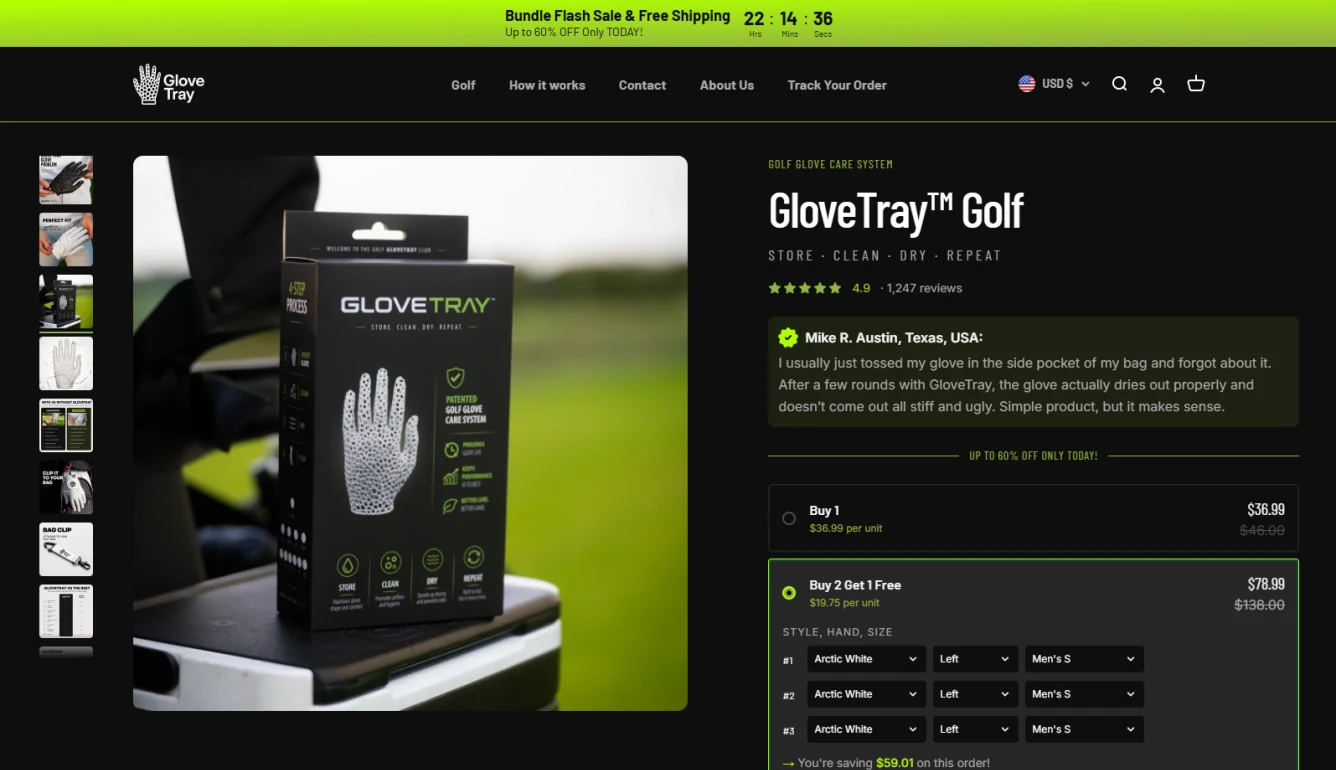
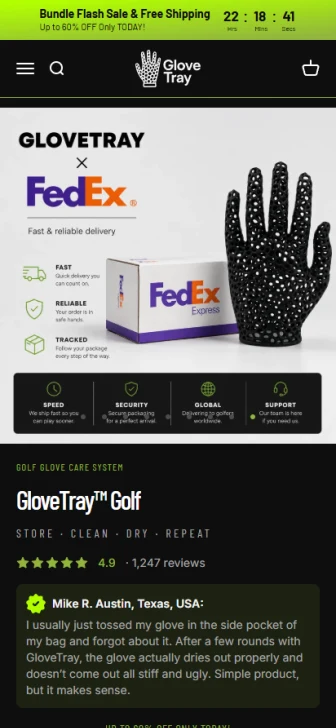

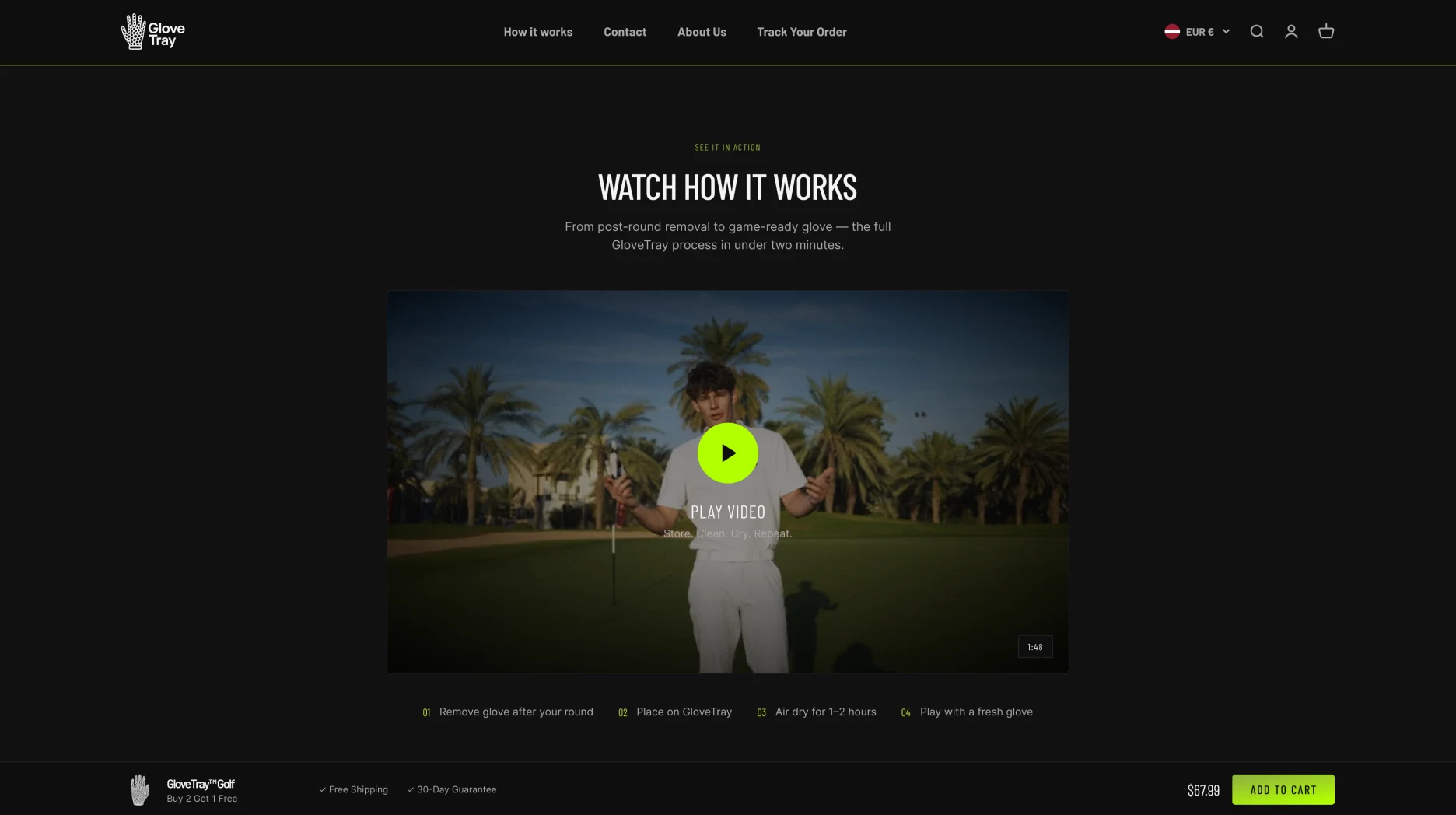
- Product-page CRO redesign completed in Figma
- Microsoft Clarity implemented
- Latvijas Pasts shipping-label automation
GloveTray

GloveTray already had a functioning eCommerce business selling primarily into the USA. The Shopify store had largely been built internally using a relatively basic/free-theme setup. The business was already generating sales, but the website had significant room for improvement from a UI/UX, CRO, and eCommerce performance perspective and had not been professionally structured around conversion optimization.
- USA
- theglovetray.com
- Shopify

Services Provided:
- Shopify CRO
- Product Page UX/UI Redesign
- Shopify Development
- Microsoft Clarity
- Fulfillment Automation
The Challenge
The Starting Point
GloveTray already had a functioning eCommerce business selling primarily into the USA. The Shopify store had largely been built internally using a relatively basic/free-theme setup. The business was already generating sales, but the website had significant room for improvement from a UI/UX, CRO, and eCommerce performance perspective and had not been professionally structured around conversion optimization.
What the Client Believed Was Wrong
The client understood that the existing Shopify experience was limiting the brand’s potential. The website needed stronger product positioning, clearer communication, better UX, more trust, and a more conversion-focused customer journey. The broader website needed improvement, but the immediate question was how to improve performance without waiting for an entire website redesign.
What Had Already Been Tried
The existing Shopify store had largely been created internally and was already successfully processing sales. However, it had not undergone a professional CRO-focused redesign or a structured behavioral optimization process.
Why It Needed Attention
Seasonality made speed critical. GloveTray was already in an important sales season and did not want to wait for a complete website redesign before making improvements. The decision was therefore to identify the page closest to revenue, improve it first, and launch while the season was still commercially important.
Risk of Doing Nothing
GloveTray could continue generating sales, but the company would move through an important sales season with an underoptimized product experience. Existing traffic would continue reaching a product page that did not communicate the product’s benefits, offer, trust, social proof, and educational content as effectively as possible, leaving potential conversion opportunities unrealized.
Constraints That Shaped the Solution
Speed and seasonality were major constraints. A complete redesign would take too long to capture the immediate commercial opportunity. GloveTray also has a relatively focused product range, meaning a traditional multi-product eCommerce journey is less important than optimizing the Product Page → Purchase journey.
What Success Needed to Mean
Launch a substantially stronger and more conversion-focused product experience quickly enough to benefit from the active sales season, while establishing a reusable foundation for future Baseball positioning and broader Shopify improvements. Operationally, success also means reducing unnecessary manual fulfillment work.
Our Approach
-
What the Evidence Showed
The biggest immediate opportunity was not the entire website — it was the Golf product page. Because GloveTray has a relatively simple purchasing journey centred around its core product, the product page plays an unusually important role in conversion. The existing experience had significant opportunities around product positioning, offer presentation, trust, benefits, social proof, product education, purchase decision-making, and conversion.
-
What We Prioritized First
Golf Product Page → Post office automation → Microsoft Clarity → Testing → Launch. The product page was prioritized because it sits directly between customer interest and purchase, while seasonality meant launching quickly had greater commercial value than waiting for a complete website transformation.
-
How We Delivered It
Instead of delaying improvements until a complete website redesign could be completed, WD Market isolated the highest-impact commercial page and created a new CRO-focused Golf product-page experience in Figma. The project includes product-page UX/UI design, CRO-focused structure, Shopify development, project management, testing, Microsoft Clarity setup, and Latvijas Pasts shipping-label automation.
-
How the Engagement Evolved
The project established a framework for evidence-based optimization after launch. Microsoft Clarity is being added so future decisions can be based on actual customer behaviour rather than assumptions. Once sufficient data has accumulated, WD Market can analyze where customers hesitate, which sections they ignore, where they abandon, mobile UX problems, offer confusion, unanswered product questions, and other conversion friction.
The People Behind The Work
CRO / eCommerce Strategy, UX/UI Designer, Shopify Developer, Project Management & QA / Testing.
-

Jānis Strautiņš
Support Team Lead
Focus: Support · Troubleshooting · Coordination
-

Tomass Bērziņš
Head of E-Commerce & Co-Owner
Focus: Growth strategy · CRO · Customer Journey
-

Deins Grets
Head of UI/UX & CRO
Focus: UI/UX · Usability · Customer Journeys · CRO
-

Anush Avetisyan
QA Team Lead
Focus: QA · Payments · Integrations · Release Quality
-

Mark Jayvee Aivan Vargas
Developer
Focus: Shopify Development
-

Mārcis Motcats
E-commerce System Engineer
Focus: Full-scale enterprise systems · Automation Workflows · Technology



 25+ Developers, Designers, CRO Specialists & others
Strategic Decisions
-

Recommendation
Rather than treating a complete website redesign as the immediate priority, WD Market recommended improving the page closest to revenue first. The broader redesign remains relevant, but it should not delay improvements that can be launched during the current sales season.
-

What We Deliberately Did Not Recommend
We did not recommend waiting until the entire website could be redesigned before making improvements. The stronger commercial decision was to isolate the highest-impact part of the funnel, launch it quickly, collect behavioral data, and then use that evidence to determine subsequent improvements.
-

Rebuild / Redesign / Spend Decision
We prioritized the Golf product page and improvements closest to the purchase decision over a full-site redesign as the first step. The wider Shopify experience can then be progressively redesigned after the highest-impact changes are live.
Results We Delivered
-
Measured Results
Golf product-page CRO redesign completed in Figma and implementation underway; Shopify development; Microsoft Clarity implementation; and Latvijas Pasts shipping-label automation. The immediate next stages are testing and launch during the current season.
-
Evidence and Metrics
GloveTray already had meaningful existing eCommerce demand, demonstrating that the core product and acquisition model were working. This made CRO particularly relevant because improvements could focus on converting existing demand more effectively. Microsoft Clarity is also being implemented to create deeper behavioral evidence through session recordings, heatmaps, scroll behavior, rage clicks, dead clicks, product-page behavior, and conversion-friction analysis.
-
What the Client Gained Beyond the Metric
GloveTray is gaining a scalable eCommerce optimization framework rather than simply a one-off visual redesign. The new Golf product-page structure can become the foundation for a future Baseball-specific version, allowing the same core technical framework to be adapted through new messaging, imagery, benefits, social proof, and use cases. The Latvijas Pasts integration also creates operational value by reducing manual work associated with shipping-label creation.