
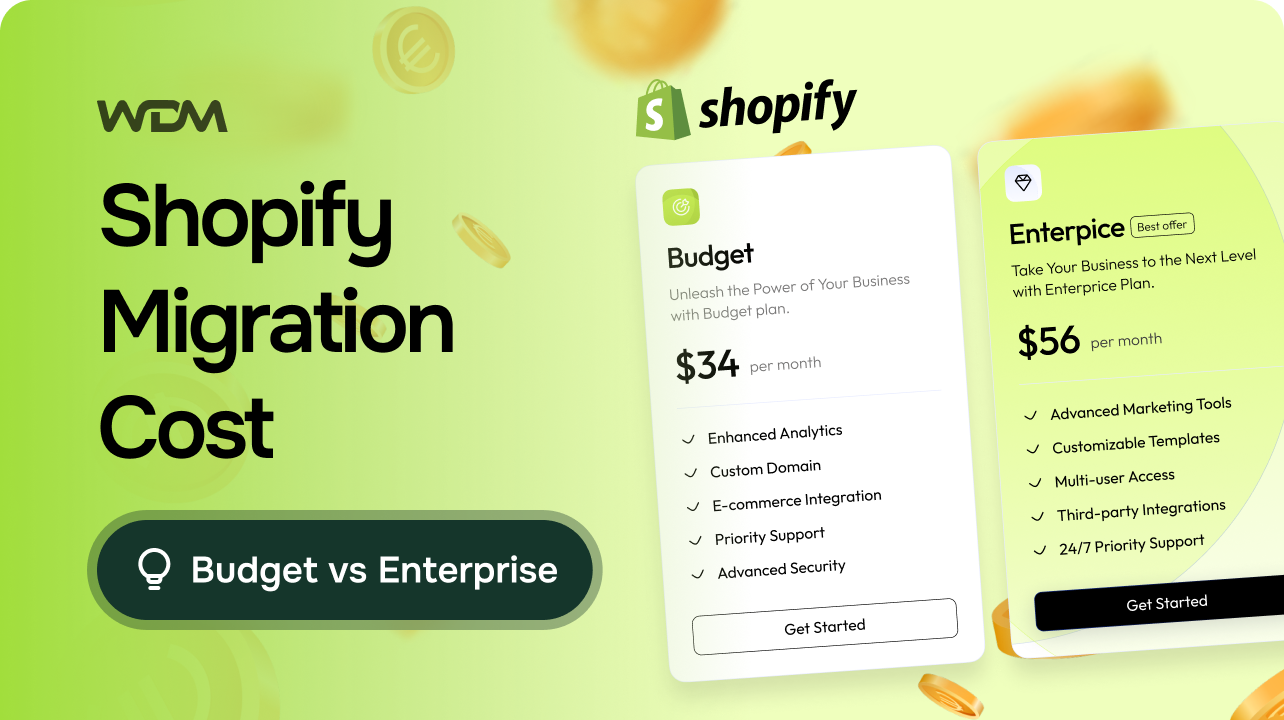
Your current platform may already be costing you more than a strategic Shopify migration.
For a growing e-commerce brand, technical debt quickly becomes a revenue problem. Slow launches, fragile workflows, and constant developer dependency can hold back campaigns, checkout performance, and scale.
That is why the real question is not only: “How much does a Shopify migration cost?”
It is: “How much is your current platform already costing the business?”
Depending on your revenue, catalog size, and technical setup, a Shopify migration can cost anywhere from $5,000 to $100,000+.
This guide breaks down what drives Shopify migration cost, why prices vary, and which migration level fits your business. If you are still mapping the full process, read more in our ultimate Shopify migration guide.
What Drives Shopify Migration Cost
A professional Shopify migration estimate is never an arbitrary number. E-commerce agencies and engineering partners calculate your project costs based on four variable dimensions of your business:
1. Data Volume and Cleanliness
The more products, customers, orders, and historical records you need to move, the more time the migration takes. Messy data can create real launch problems: missing products, incorrect customer details, and broken order history.
2. Front-End Architecture
Your storefront design approach dictates a significant portion of the budget. A premium Shopify theme is quicker to adapt. A fully custom design takes more planning, UX work, and development time.
3. Store Integrations
The technical effort required heavily depends on the complexity of connecting your new storefront to existing back-office machinery. This includes connecting Shopify with systems such as WMS, ERP, and fulfillment tools.
4. Traffic Security and SEO Risk Management
This involves the specialized technical work required to protect your digital footprint. Engineers should map redirects and metadata carefully, following Shopify’s SEO migration checklist.
This helps protect rankings, domain authority, and organic traffic after the switch.
Shopify Migration Cost Comparison Matrix
| Expense Variable | The Growth Budget ($5,000 – $25,000) | The Enterprise Overhaul ($30,000 – $100,000+) |
| Ideal Operational Profile | Brands tracking between $1M and $5M in annual sales | Market leaders processing $5M to $50M+ globally |
| Shopify Infrastructure Tier | Shopify Advanced | Shopify Plus |
| Catalog Scope | Under 5,000 SKUs with standard configuration | 10,000+ SKUs with deep variant matrices or B2B channels |
| Storefront Engineering | Tailored Online Store 2.0 premium framework | Custom-coded storefront or headless engine |
| System Sync Complexity | Standardized app integrations (Klaviyo, Gorgias, ShipStation) | Direct API links, legacy ERP setups (NetSuite, SAP), custom middleware |
| Typical Implementation Window | 4 to 8 weeks | 3 to 6 months |
Tier 1: The Growth & Mid-Market Budget ($5,000 – $25,000)
Final Thoughts
At the lower end of Shopify migration cost, this tier fits businesses with stable mid-market revenue and a simple store setup. It helps them move faster, clean up old store assets, and reduce the need for constant developer support.
The Budget Migration Process
At this level, the technical workflow follows a highly efficient, streamlined path:
- Extraction: Automated API bridges securely extract core data fields from your legacy platform.
- Transfer: The data is funneled directly into the Shopify Advanced core engine.
- Deployment: The agency configures the Online Store 2.0 theme and connects standard plug-and-play apps.
Who This Path Is For
This path fits DTC brands with simple product lines, moderate catalog sizes, and lean teams. They do not need complex legacy integrations. They need a fast, reliable Shopify storefront that lets the marketing team launch campaigns without waiting on developers.
What This Budget Usually Covers
A growth-level Shopify migration focuses on moving your business safely and quickly without costly custom development. This budget targets practical execution across a few essential areas.
First, it covers core data migration, safely transferring products, active customer profiles, collections, and order history to Shopify.
Next, developers adapt a premium Online Store 2.0 theme to match your brand’s fonts, colors, and layouts. They also connect standard apps for email marketing, reviews, customer support, and shipping. To safeguard your traffic, it includes SEO essentials like mapping 301 redirects and preserving metadata.
Finally, the team tests checkout, product pages, and mobile performance before launch.
Financial Insight
If this tier fits your business, you can save money by avoiding unnecessary custom development. A premium Shopify theme can handle strong traffic and mobile shopping without a fully custom build. Directing your budget toward impeccable data cleanliness and reliable app configurations will yield a far better immediate margin than overpaying for custom visual code.
Tier 2: The Enterprise Overhaul ($30,000 – $100,000+)
For international brands, multi-channel wholesalers, and high-volume operations, a Shopify migration is a high-stakes infrastructure upgrade. At this scale, the digital storefront is the central nervous system of a massive corporate supply chain.
The Enterprise Data Pipeline
Because the business risk is much higher, executing an enterprise-level Shopify migration requires a layered, carefully planned setup:
- Data cleanup: Engineers clean old records before moving them into Shopify. This includes duplicate customers, incorrect SKUs, broken variants, and outdated order data.
- Shopify Plus setup: Clean data is then moved into Shopify Plus and prepared for the new store structure.
- Enterprise store setup: At the same time, engineers build the main parts of the new setup. This can include a custom storefront, international stores, and ERP syncs with SAP or Oracle. It can also include separate B2B or wholesale channels.
Who This Path Is For
This path fits businesses with complex technical needs. This may include international sales, separate B2B or wholesale channels, and custom product tools. It may also include integrations with systems like NetSuite, SAP, or Sage.
To properly execute a large-scale project, the development team must address several foundational layers of your corporate infrastructure.
Why Enterprise Shopify Migration Cost More
Standard plug-and-play tools are usually not enough at this level. The migration needs custom engineering across several key parts of the business.
First, engineers clean and prepare old records before moving them into Shopify. This includes transaction history, product variants, customer records, and any data that has become messy over time.
Next, the storefront usually needs more than a premium theme.
Designers and developers create layouts, interactions, and page components around the brand’s guidelines and conversion goals.
The setup also needs deeper system connections. Engineers build custom API links so inventory, accounting, and fulfillment systems can sync with Shopify in real time. This reduces manual warehouse work and keeps business data aligned.
For global or wholesale brands, the migration may include separate stores for different markets. It may also include B2B or wholesale portals inside one Shopify admin.
Finally, the team protects organic traffic before launch. They check old URLs, redirects, metadata, and key pages, then test the new store to reduce the risk of broken links or traffic drops.
Financial Insight
In the enterprise bracket, you aren’t just paying for a fresh design; you are paying for comprehensive risk mitigation. If the store earns tens of thousands of dollars per hour, even a small launch issue can become expensive. This tier includes senior planning, full testing, and custom system integrations to keep the migration stable.
Extra Shopify Migration Costs to Plan For
The agency quote is only one part of the full migration budget. You also need to plan for platform fees, app subscriptions, and internal team time.
1. Platform Licensing Tiers
Your ongoing monthly platform investment scales alongside your functional requirements:
- Shopify Advanced costs $299 per month. It includes stronger analytics and lower transaction fees for growing mid-market stores.
- Shopify Plus starts at $2,000 per month. It gives larger brands more control over checkout, B2B selling, payment rates, and international storefronts.
You can compare the current Shopify plan pricing before finalizing your migration budget.
2. Specialized Software Subscriptions
Shopify can reduce the number of plugins your store needs just to function. However, some advanced tools will still remain part of your monthly budget. This may include loyalty apps, AI search tools, and subscription apps. It can also include review platforms or other software your team uses for marketing and daily operations.
3. The Internal Labor Investment
A major system upgrade requires active participation from your executive team and department heads. Your marketing, inventory, and customer support teams will need time for reviews, testing, and training. They may need to check store assets, confirm that workflows work correctly, and learn how to use the new Shopify setup. Be sure to account for this focus shift when mapping out your internal company goals for the quarter.
Final Thoughts
You do not need a fully custom enterprise build if a strong premium Shopify theme can support your growth.
But if your store has complex data, ERP connections, wholesale channels, or high SEO risk, the project needs more care. A cheap migration can create bigger problems later.
The right Shopify migration cost should match the real complexity of your store. A good partner will review your data, integrations, design needs, and traffic risks before recommending the best setup.
Not Sure Which Migration Budget Fits Your Store?
Plan your Shopify migration cost with more clarity. We will review your data, SEO risks, integrations, and storefront needs. Schedule your free 30-min migration audit today!