
Running an established e-commerce store often means hitting invisible walls. You’ve built steady revenue and reliable traffic. But suddenly, basic updates take weeks, peak sales crash the site, or your dev team spends more time firefighting than building growth features. This is when platforms stop serving your ambition.
For established stores with meaningful monthly revenue, migration isn’t about starting over. It’s about upgrading infrastructure to match your scale.
This guide walks through that evaluation neutrally. No platform bashing. Just clear tradeoffs for decision-makers who need to justify the switch to stakeholders. When maintenance costs more than growth, migration becomes logical.
Platform Comparison
Platform choice reflects operational priorities. Established stores are selected based on current challenges and growth goals:
- Self-hosted platforms (WooCommerce, Magento) prioritize infrastructure control
- SaaS platforms (Shopify, BigCommerce) emphasize operational reliability
Each approach offers distinct tradeoffs in management, scaling, and extensibility.
Platform Hosting and Management Models
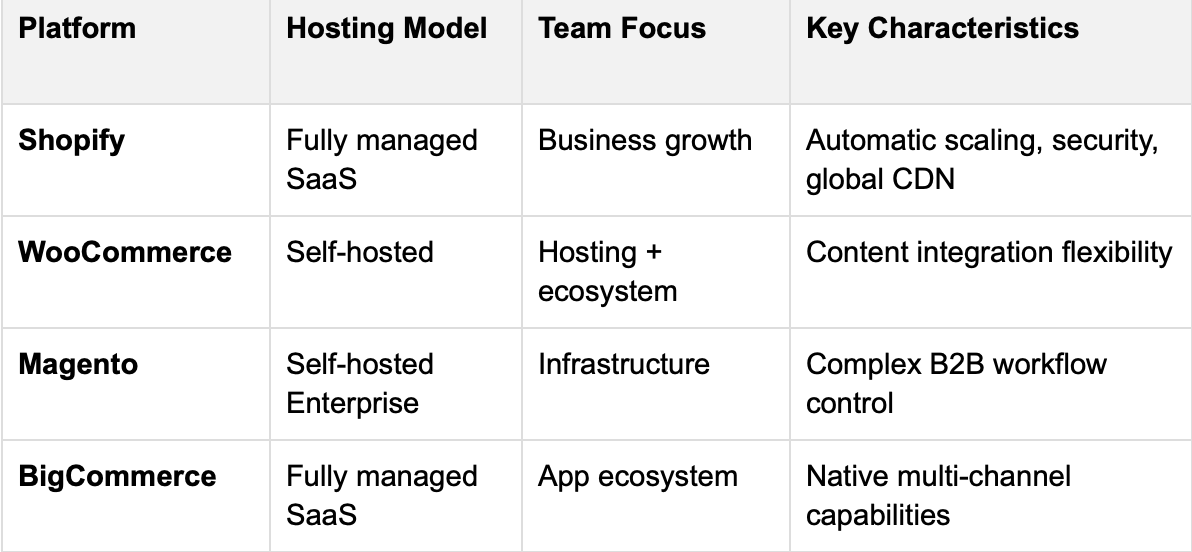
Strategic choice: Infrastructure ownership vs. operational focus.
Ease of Customization and Feature Access
Extensibility evolves with business maturity. Early stage: Code-level flexibility drives experimentation. Growth stage: Speed-to-market becomes a priority.
Platform approaches:
- WooCommerce: Extensive plugin ecosystem enables broad functionality
- Magento: Deep code customization supports complex enterprise needs
- BigCommerce: Strong native features reduce app dependency
- Shopify: 8,000+ vetted apps + Shopify Functions for rapid deployment
Migration insight: Established stores value deployment velocity over code ownership.
Scalability for High-Traffic Stores
Scale reveals platform character.
Traffic patterns expose operational differences:
- Shopify: Global infrastructure handles peak surges automatically
- WooCommerce: Capacity depends on hosting configuration
- Magento: Enterprise-grade with dedicated infrastructure
- BigCommerce: Built-in CDN supports mid-market growth
Key decision factor: Infrastructure management vs. business focus. Stores migrate when scaling demands exceed internal capacity.
Cost Structure at Scale
True costs emerge beyond monthly fees.
Platform economics:
Self-hosted (Woo/Magento): Low base + high operational overhead
SaaS (Shopify/BigCommerce): Predictable pricing + ecosystem costs
Growth-stage reality:
- Development time compounds on self-hosted platforms
- SaaS includes infrastructure, trading fees for reliability
Stakeholder conversations focus on opportunity cost—revenue potential unlocked by operational freedom.
WD Market’s “Best e-commerce platform guide” introduces platform cost factors at different business stages.
Migration Guide
A systematic approach minimizes risk.
The four-step process builds confidence at each stage.
Step 1: Audit Current Setup
Complete inventory creates clarity.
Document:
- Products, customers, orders
- Custom code and integrations
- Third-party dependencies
- SEO structure
Reveals: Technical debt and true customization scope.
Step 2: Match Features to Shopify Ecosystem
Feature mapping eliminates surprises.
Examples:
- WooCommerce subscriptions → Bold Subscriptions
- Magento B2B pricing → Wholesale Club apps
- BigCommerce APIs → Shopify Flow automation
Key insight: 80% functionality often exists as marketplace solutions.
WD Market’s “Magento guide” explores enterprise-level customization and development considerations.
Step 3: Test Parallel Operations
Live validation builds confidence.
2-4 weeks staging:
- Mirror live inventory
- Test all checkout flows
- Validate mobile experience
- Stress test peak capacity
Teams witness seamless operation before commitment.
Step 4: Redirect and Launch
Precision execution preserves continuity.
Critical actions:
- Comprehensive 301 redirects
- Managed DNS cutover
- 48-hour monitoring window
Success feels routine when preparation matches execution.
Real-World Scenarios for Your Business
WooCommerce → Shopify
Plugin conflicts slowed updates. Migration preserved content while gaining reliability and app velocity.
Magento → Shopify
Dev dependency exceeded business value. Gained managed scale with strong feature parity through apps.
BigCommerce → Shopify
Native limits constrained personalization. Deeper app ecosystem accelerated omnichannel growth.
Final Thoughts
Migration timing signals platform maturity.
Common triggers:
- WooCommerce: Plugin ecosystem complexity
- Magento: Infrastructure overhead
- BigCommerce: Feature velocity limits
Shopify serves stores prioritizing:
- Managed infrastructure over code control
- Ecosystem leverage over custom builds
Success hinges on process discipline, not platform choice alone.
Established e-commerce store owners and managers can reach out to WD Market to discuss platform migration considerations for their specific operations across Shopify, WooCommerce, and Magento.
Our team provides neutral guidance on infrastructure tradeoffs and growth alignment.