
When it comes to GEO for e-commerce, if you want to optimize product pages for AI search 2026, the old rules no longer apply.
“The best place to hide a dead body is page two of Google search results.” That old joke died in 2025.
In 2026, there is no “page two” because GEO for e-commerce has completely changed user behavior.
This is driven by a massive shift in behavior: 72% of consumers now report using generative AI-powered search for their shopping needs.
Relying on 2022-style keywords leads to lost rankings and total invisibility to the systems that now dictate how people buy. Search has shifted from “matching words” to “understanding intent.”
Optimization today is about making your data digestible for Large Language Models (LLMs) while remaining persuasive for human beings.
1. How AI Finds Your Products: GEO for E-Commerce Basics
Traditional SEO was built on strings – specific sequences of letters like “waterproof running shoes.”
AI Search (SGE, Perplexity, OpenAI Search) operates on entities and context. Instead of just looking for the words, it looks for the “meaning” of your product.
In 2026, an AI agent doesn’t ask, “What sites have the keyword ‘running shoes’?” It asks, “Which product is best for a marathon runner with wide feet who lives in a rainy climate?”
If your product page doesn’t explicitly provide the data to answer that specific query, you won’t be the recommended option. This shift requires you to optimize product pages for AI search 2026 by moving beyond simple meta tags and focusing on semantic relevance.
2. The Technical Foundation: Schema and JSON-LD
AI engines depend on high data volume and strict structural organization.
They prefer structured data because it removes ambiguity. While a human can infer that “$45” is a price, an AI wants to see it wrapped in specific code.
To stay relevant, your technical infrastructure – whether you rely on Shopify support or WooCommerce support – must prioritize advanced Schema markup.
Here are some key schema types for 2026:
- Product schema: Includes price, availability, brand, and SKU.
- Review schema: High-quality, verified reviews that AI uses for sentiment analysis.
- FAQ schema: Directly answers the conversational questions AI agents are likely to ask.
- Shipping and returns schema: AI often filters results based on “free shipping” or “30-day returns” before the user even sees the product.
This shift in technical requirements changes how we define success for every on-page element.
To see how traditional SEO goals compare to the new AI-driven standards, let’s look below:
| Element | Old SEO Goal | AI Search Goal (2026) |
| Title | Keyword density | Entity clarity & brand authority |
| Description | Human readability only | Semantic context for LLM training |
| Images | Alt-text for accessibility | High-res metadata for visual search |
| Data Format | HTML | JSON-LD + Semantic HTML5 |
3. GEO for E-Commerce: How to Optimize Product Pages for AI Search 2026 Using Content
You are now writing for two audiences: the human shopper and the AI algorithms. The human wants emotion and benefits, the AI wants specifications and context.
Stop using “fluff” adjectives. Words like “amazing,” “incredible,” or “the best” are ignored by AI. Instead, use high-utility data.
Example:
Instead of: “This incredible jacket is perfect for all your outdoor adventures!”
Use: “This lightweight, Gore-Tex hardshell jacket is designed for alpine climbing in temperatures as low as -10°C.”
The second version provides “entities” (Gore-Tex, alpine climbing, -10°C) that an AI agent can use to match a user’s specific request. This level of detail is a core component of conversion rate optimization, as it builds immediate trust with both the bot and the buyer.
4. Visual Optimization
In 2026, visual search is a primary entry point. Google Lens now processes over 20 billion searches per month, and 1 in 4 of those have commercial intent.
To capture this traffic, your store must support:
- Clear photos from multiple angles: AI uses these to “model” the product in a 3D-like understanding.
- Descriptive image file names: men-waterproof-hiking-boot-brown.jpg is far superior to IMG_0042.jpg.
- Contextual visuals: Images showing the product in use (lifestyle shots) help AI understand the “setting” or “use case” of the item.
5. Performance as a Ranking Factor
AI search engines value efficiency.
If an AI agent attempts to access your page to verify stock status or price and the page takes 5 seconds to respond, that agent will deprioritize your store.
Speed is now a technical necessity for AI search tools to find and list your products.
If you want to win at GEO for e-commerce, high-performance hosting and clean code are non-negotiable. If your site feels laggy, it may be time for a technical audit to ensure your store is actually delivering the speed modern search requires.
6. The Discovery Score Formula
We can think of your “Discovery Probability” (Pd) in AI search results as a function of your technical accuracy (T), content relevance (C), and brand authority (A).
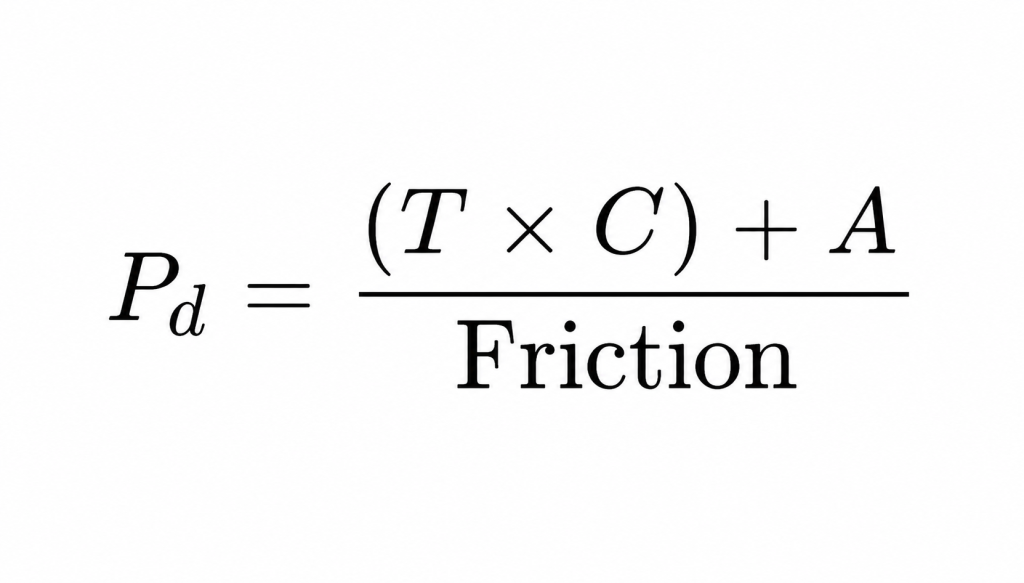
- T (Technical): Schema, speed, and mobile-first architecture.
- C (Content): Depth of specs and semantic clarity.
- A (Authority): Backlinks and verified user reviews.
- Friction: High bounce rates, slow load times, or broken links.
To maximize your discovery probability (Pd), you must minimize friction while ensuring your technical and content scores are multiplying each other’s effectiveness.
7. Social Proof and Sentiment Analysis
AI search engines ignore simple product descriptions. Instead, they analyze what everyone else says about your brand.
They perform sentiment analysis on your reviews.
Quantity matters: 68% of consumers won’t trust a high rating unless it has a large volume of reviews.
If 100 people say your “size runs small,” the AI will learn that. When a user asks for a “true-to-size” jacket, the AI will skip your product.
This makes email marketing a vital SEO tool.
By using automated post-purchase flows to gather detailed, honest reviews, you are feeding the AI the “social proof” data it needs to recommend you. A product with 50 detailed reviews describing specific use cases will always outrank a product with a generic 5-star rating and no text.
8. The Implementation Roadmap
Implementing GEO for e-commerce is not a one-time task.
It is a continuous process of refining how your store communicates with the global AI infrastructure.
- Review your top products. Ensure descriptions clearly answer who the product is for and how it is used.
- Ensure every product has comprehensive JSON-LD. If you are on Magento or WooCommerce, check for conflicting plugins that might be breaking your Schema.
- Achieve a sub-1-second response time. AI bots are high-volume and will skip slow servers.
- Build an FAQ section using real customer questions. This “question-answer” format is exactly what LLMs prioritize.
Final Thoughts
In 2026, think of your product page as a data source for AI, not just a page for people to land on.
The winners are stores that give AI clear, organized information while keeping the shopping experience easy for humans.
Our advice? Stop wasting time on old SEO tricks.
Instead, focus on being the most helpful and honest answer to your customer’s problem. If you make your data clear for the machines and your content useful for the people, the rankings will follow.
Is your product data ready for the AI shift?
We build stores that turn AI visibility into revenue. Book your free 30-minute AI audit.